Email Attachment Transformer
Can't email your important files through? Tired of being messed about? Then pack them inside an image with Email Attachment Transformer and send them off.
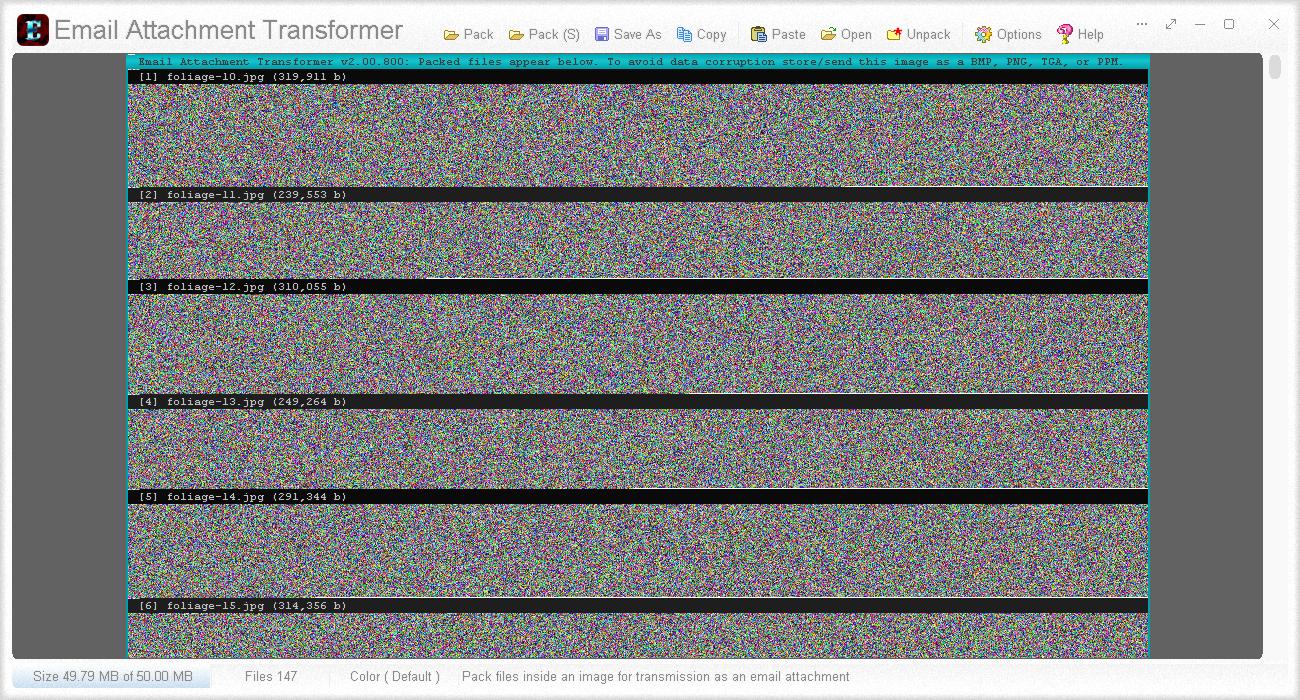
A visual label proceeds each packed file for clear reference
- Various pack options: Pack folder files (all files in a folder), pack folder files and sub-folders (all files in a folder and its sub-folders), or pack dropped files
- Store upto 50 MB of files (more with compression)
- Pack fast and without fuss with auto clear. Previous content is wiped and new content packed cleanly with no need to reset, clear or start afresh between packs.
- Each file has a visual label with a number, path, name, and file size
- Automatic compression for best fit
- 8 header and footer colors: Default, Red, Yellow, Green, Blue, Purple, Pink and White
- Packed files are stored inside a single, lossless bitmap image
- Copy the image to Clipboard and paste directly into your email message, or save as a BMP, PNG, TGA or PPM and attach to your email message and send
- Email recipient can easily drag and drop the image straight onto Email Attachment Transformer, or paste it in from Clipboard, or load it up from file, and click the "Unpack" link for a temporary folder with all files unpacked ready for access.
- Both sender and recipient require a copy of Email Attachment Transformer
- Options Window - Easily change app color, font, and settings
- Portable
Information
App Name
Email Attachment Transformer
Version
2.0.815
Type
Desktop App (Standard Edition)
License
MIT
Status
-
Release Date
27th November 2025
Portable App
Yes
Code Foundation
4th Generation (Gossamer for GUI)
Operating System(s)
Windows All and Wine for Linux and Mac
SHA256 Checksum
for "eat.exe"
EAD780447DC6C8C686A0CD5B6F1612B1101384C03E0A3E393E77394355AC87AA
Downloads
Images
A visual label proceeds each packed file for clear reference
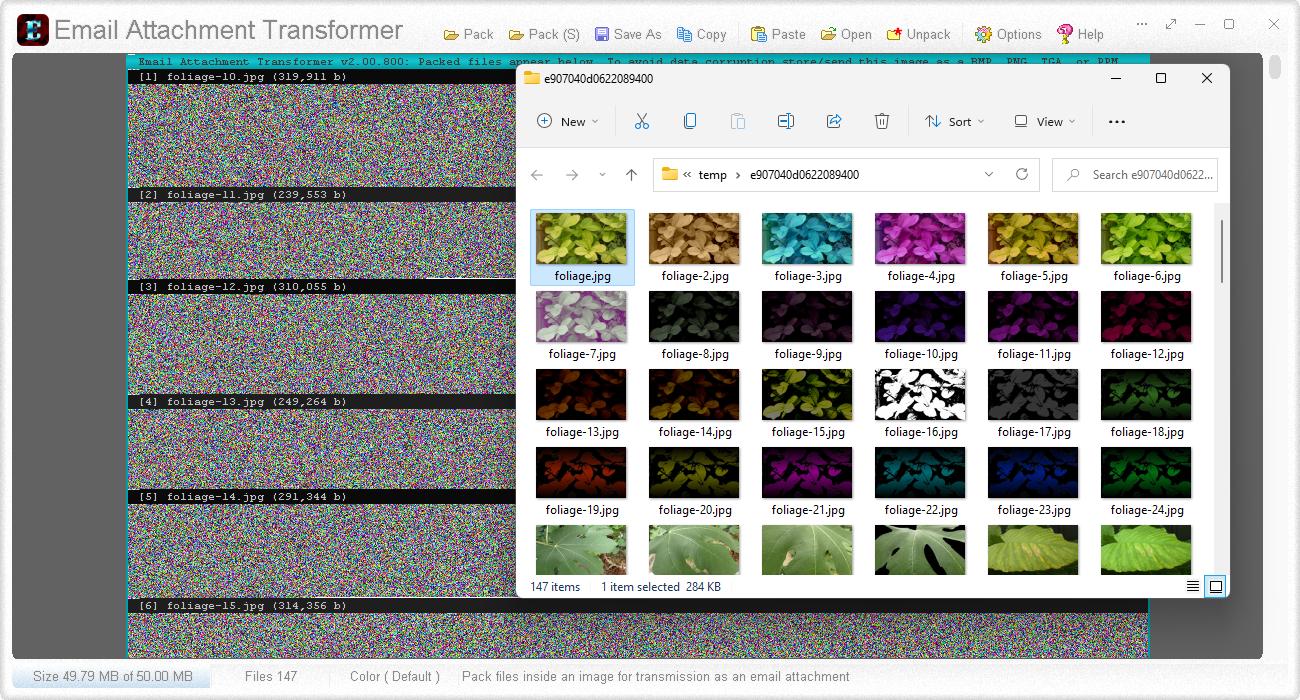
Click the "Unpack" button for a temporary folder with all files unpacked ready for access
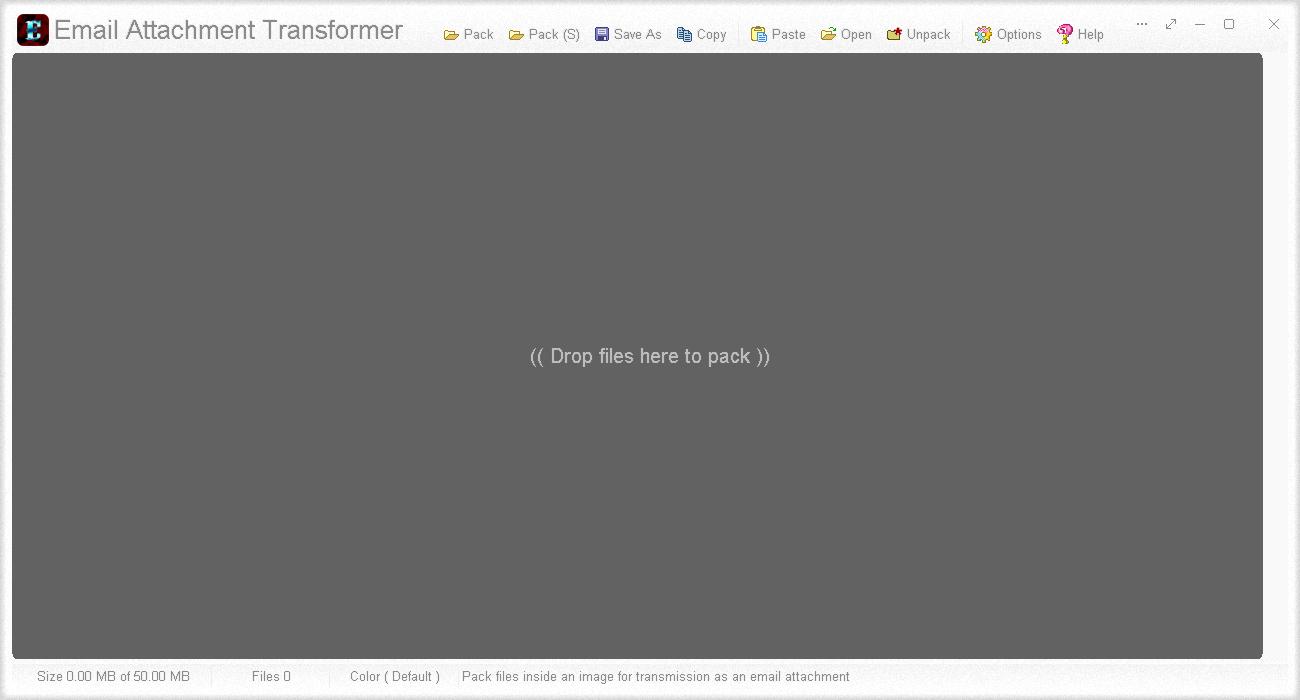
Drop a selection of files to pack them
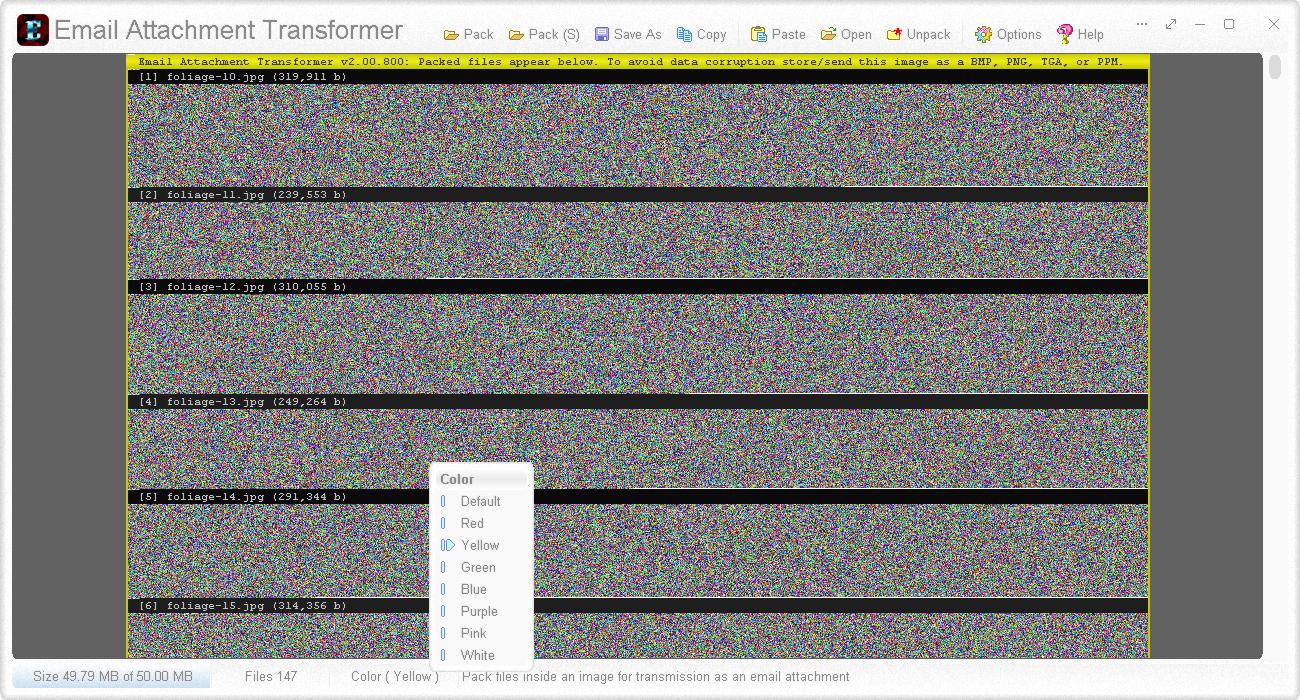
Files packed using a yellow header and footer color
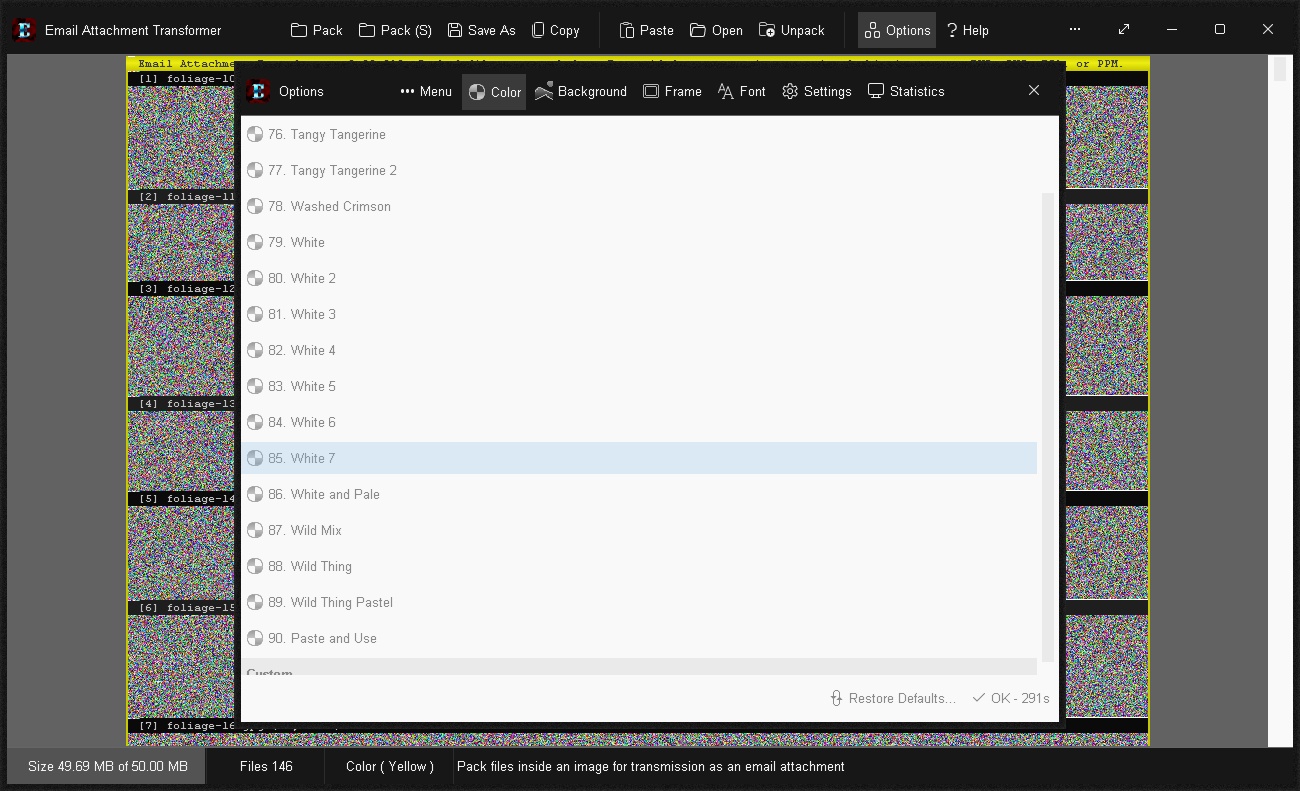
Email Attachment Transformer colored with the Deep Yellow 2 color scheme - "Options > Color"
Reference
What makes a portable app special?A portable app is a big leap forward for apps in general. A standard or traditionally engineered app requires a lot of support in the form of libraries, data files, images, scripts, etc and the list goes on. You get the picture. Some portable apps out there still include this bundle of bits, they merely offload it into a local folder. A dump of goodies of sorts.
We tend to see a portable app in quite a different light. Our vision of a portable app is designed tight, clean, free of bloat, and all data where possible is included directly within, structured right into the fabric of the app itself, and designed from the bare-metal up if required.
Though the most important difference between a traditional app and a portable app is that a portable app will not install on your computer. This is extremely important as the installation process is often messy, and can clutter up your computer by dumping a lot of stuff all over the Windows file structure and registry, and over time may slow down and decrease the overall performance of your computer.
A portable app will not do this, which keeps your computer clean and running smooth and fast as it should. Unfortunately most software is not designed with portable in mind. They're more akin to a large leaky box of bits than tight engineering. And because a portable app is not installed on your computer, it runs outside the normal scope of the operating system, and is not locked down or tied to it. And thus can be moved about, from disk to disk, or computer to computer.
Typically a portable app will reside on a USB pen stick, removable media, or in a special folder on a portable hard disk. This makes it easy to take from one computer to the next, and use over and over. An immensely valuable freedom, and something an installed app can only dream of.
But a serious technical hurdle must be overcome for a truly portable app to be free. And that is the humble setting. Yes, a portable app must be able to handle it's settings on it's own. It must be able to read them from disk, filter them, check and correct them where required, and write them back to disk. All without the help of the Windows' registry or other operating system dependent structures.
An installed app typically can't or won't do this. Instead, it relies on Windows and the registry to manage it's settings and other important data sets for it. It therefore takes a higher degree of technical competence to escape this "tied to the operating system" situation.
Here is our current standard for a portable app:
- Require no installation or setup
- Require no additional DLL libraries to run and perform it's core function
- Make no alteration to the host operating system, or its settings, files, libraries or core functions, or the Windows registry, unless it forms a part or a whole of the app's core function, and then, only when initiated by the user
- Be able to run "out of the box"
- Require no compiling, conversion, installation or setup of support structures in order to execute, except for when such an environment constitutes an execution enabling environment, such as a command translation service like Wine
- Be free of zipped or otherwise externally bundled blob structures containing folders, files and bits
- Operate on less powerful hardware to facilitate operation on a broad spectrum of computers
- Less demanding API landscape to facilitate execution on a broad range of operating systems and software translation environments
- Require no special software libraries be present in order to run, such as .NET or JAVA, unless typically pre-installed on the target operating system or execution environment
- Not require an internet connection to run, unless the connection is required to fulfill the app's core function, such as a web server
- Require no downloads, addons, or registration in order to run
- Provide help and documentation offline via a built-in viewer, or by limited external means, such as Notepad
- Be self-contained with all necessary files, data sets, and samples stored within it's internal structure, such that access be provided preferably through direct enabling mechanisms
- Store, hold and manage external app settings and user data in a local sub-folder, and that sub-folder be easily identifiable as belonging to the app
- Provide a mostly consistent appearance and experience to the user across the widest possible range of operating systems and execution environments
- Value backwards compatibility, and be able to actively make use of that older hardware and software
- Possess a compact, bloat-free footprint
⏶MIT LicenseCopyright 2026 Blaiz Enterprises (
www.blaizenterprises.com )
Permission is hereby granted, free of charge, to any person obtaining a copy of this software and associated documentation files (the "Software"), to deal in the Software without restriction, including without limitation the rights to use, copy, modify, merge, publish, distribute, sublicense, and/or sell copies of the Software, and to permit persons to whom the Software is furnished to do so, subject to the following conditions:
The above copyright notice and this permission notice shall be included in all copies or substantial portions of the Software.
THE SOFTWARE IS PROVIDED "AS IS", WITHOUT WARRANTY OF ANY KIND, EXPRESS OR IMPLIED, INCLUDING BUT NOT LIMITED TO THE WARRANTIES OF MERCHANTABILITY, FITNESS FOR A PARTICULAR PURPOSE AND NONINFRINGEMENT. IN NO EVENT SHALL THE AUTHORS OR COPYRIGHT HOLDERS BE LIABLE FOR ANY CLAIM, DAMAGES OR OTHER LIABILITY, WHETHER IN AN ACTION OF CONTRACT, TORT OR OTHERWISE, ARISING FROM, OUT OF OR IN CONNECTION WITH THE SOFTWARE OR THE USE OR OTHER DEALINGS IN THE SOFTWARE.
⏶


 eat.exe (1.62 Mb)








 Contact Us
Privacy Policy
Contact Us
Privacy Policy